Understocking means lost sales. Overstocking means waste. AI-enhanced forecasting can help retailers get the balance right.
If businesses could predict the future, inventory planning would be easy. But demand is uncertain, and companies must constantly adjust as consumer behavior, costs, supply conditions, and external shocks reshape what customers buy, when they buy it, and how much it costs to serve them. Recent energy price volatility stemming from the Middle East has raised the cost of transportation, refrigeration, packaging, and food logistics, underscoring the need for better forecasting and more resilient supply chains.
For enterprises, artificial intelligence is making forecasting more adaptive, granular, and commercially useful.
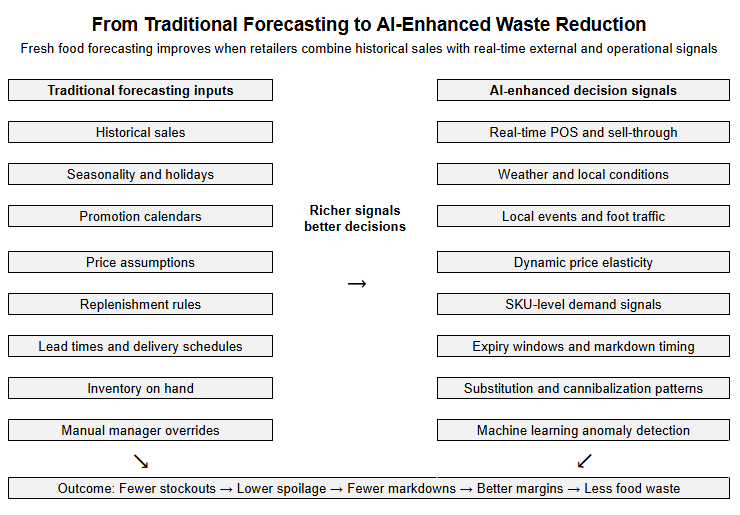
Traditional forecasting relies on a wide range of factors: past sales, seasonal patterns, promotion plans, lead times, replenishment rules, inventory on hand, and the judgment of line managers. These inputs are essential. But AI-enhanced forecasting goes even further. It combines traditional inputs with real-time internal and external signals, from point-of-sale data to local weather patterns, store-level traffic, pricing behavior, product shelf life, and local and regional events. (See chart.)
This matters because better forecasting is not just an analytical upgrade. It is an operational advantage. It can reduce waste, protect margins, improve product availability, increase inventory turns, and support better decision-making across stores, distribution centers, and merchandising teams.
The Business Case for Better Forecasting
At the store and distribution-center level, spoilage, shrink, markdowns, handling, labor, disposal, and recovery costs can add up to a material share of sales.
For perishable goods, getting the forecast right can mean the difference between an empty shelf and a shelf full of spoiled produce.
According to the Food Industry Association, the cost of shrink and recorded food losses can exceed 2% of sales, while the hidden cost of handling surplus and unsold food can add another 1.8%. Together, these costs can reach up to 3.8% of sales.
Every unsold carton of berries, prepared meals, dairy items, or bagged salads reflects a decision made under uncertainty. Order too much, and the product expires before it sells. Order too little, and the retailer loses revenue, disappoints customers, and pushes demand elsewhere.
In fresh food, forecasting errors do not sit quietly in a spreadsheet. They show up as spoilage, stockouts, markdowns, margin leakage, and weaker customer experience.
The challenge is not just to forecast demand more accurately. It’s to forecast at the right level of granularity: the right product, in the right store, at the right time, with the right shelf life remaining.
Demand for fresh food can shift quickly. A heat wave can change beverage and produce sales. A school holiday can alter weekday shopping patterns. A promotion can pull demand forward. A late delivery can shorten the time available to sell a product.
From Static Forecasts to Real-Time Signals
Traditional forecasting tools often struggle to capture these interactions quickly enough. By contrast, AI-enhanced forecasting can help retailers detect patterns earlier, update assumptions faster, and translate signals into better ordering, replenishment, markdown, and allocation decisions.
The business case is straightforward. When fast-selling goods carry strong margins, stockouts can be costly. When goods have a short shelf life, excess inventory can be just as damaging. The optimal inventory decision lies between these two costs.
Waste-reduction analytics help retailers find that balance.
By combining what a retailer already knows with what is changing in real time, companies can make more precise decisions before waste occurs.
The goal is not merely to manage waste after it shows up on the shelf. The goal is to prevent waste by improving the decisions that create it.
In a low-growth, high-cost operating environment, waste reduction is more than a sustainability reporting exercise. It is an essential driver of business performance.
The companies that succeed in grocery and food distribution will not be those that simply collect more data. They will be the companies that turn signals into better daily decisions.