
The global food system faces a transmission shock. The Middle East war has raised energy costs and caused logistics bottlenecks, and these are converging with climate risks to threaten global food security. Companies that increase operational efficiency will build resilience.
The Energy-to-Food Transmission Shock
The war in the Middle East, now in its ninth week, is disrupting more than energy markets. Ships are stranded, ports are blocked, and key shipping lanes are constrained. The result is a shock to the supply of oil and gas and the movement of food and fertilizers through global supply chains. Lower supply of these inputs has sharply increased their price.
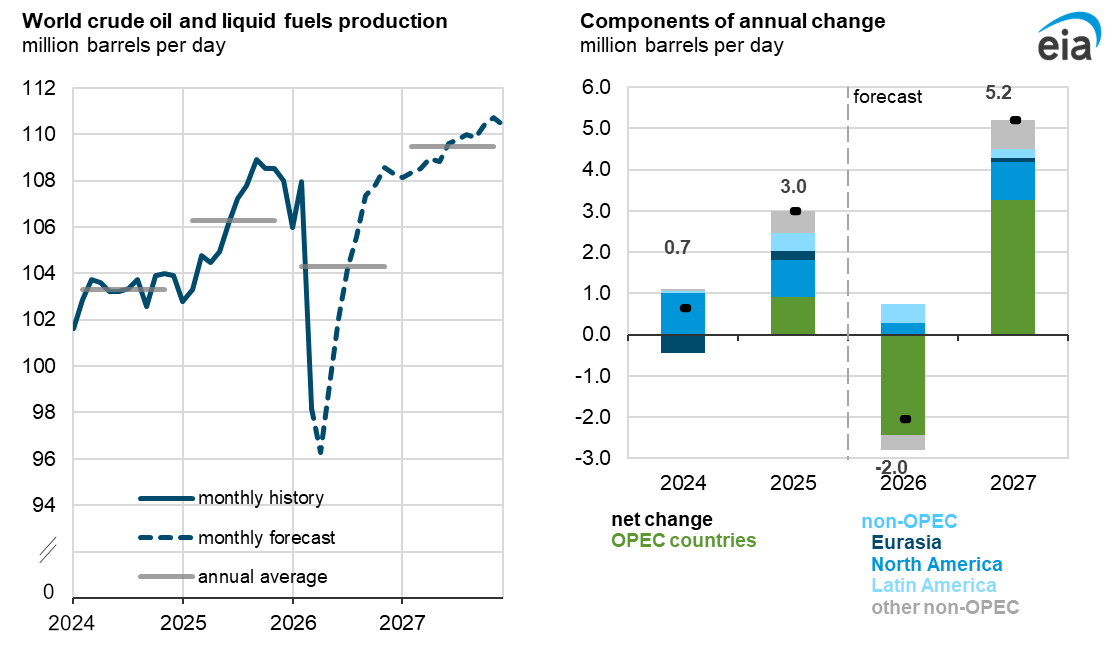
Data source: U.S. Energy Information Administration, Short-Term Energy Outlook, April 2026
One sector particularly hard hit is agriculture. Modern agriculture is highly dependent on fertilizers, particularly phosphates and nitrogen-based inputs such as ammonia and urea, which are produced using natural gas. Fertilizer is, in effect, energy in chemical form. When energy markets are disrupted, fertilizer markets follow, and with them, global food production.
The transmission mechanism from the Strait of Hormuz to global food and fertilizers is not just price, but logistics. Bottlenecks in shipping, and rising transport and insurance costs, are delaying deliveries of critical inputs. Fertilizers are not a commodity that can arrive late without consequence. Agriculture operates on tight seasonal windows. Miss the application period, and yields are permanently reduced. Unlike energy markets, lost agricultural output cannot be recovered.
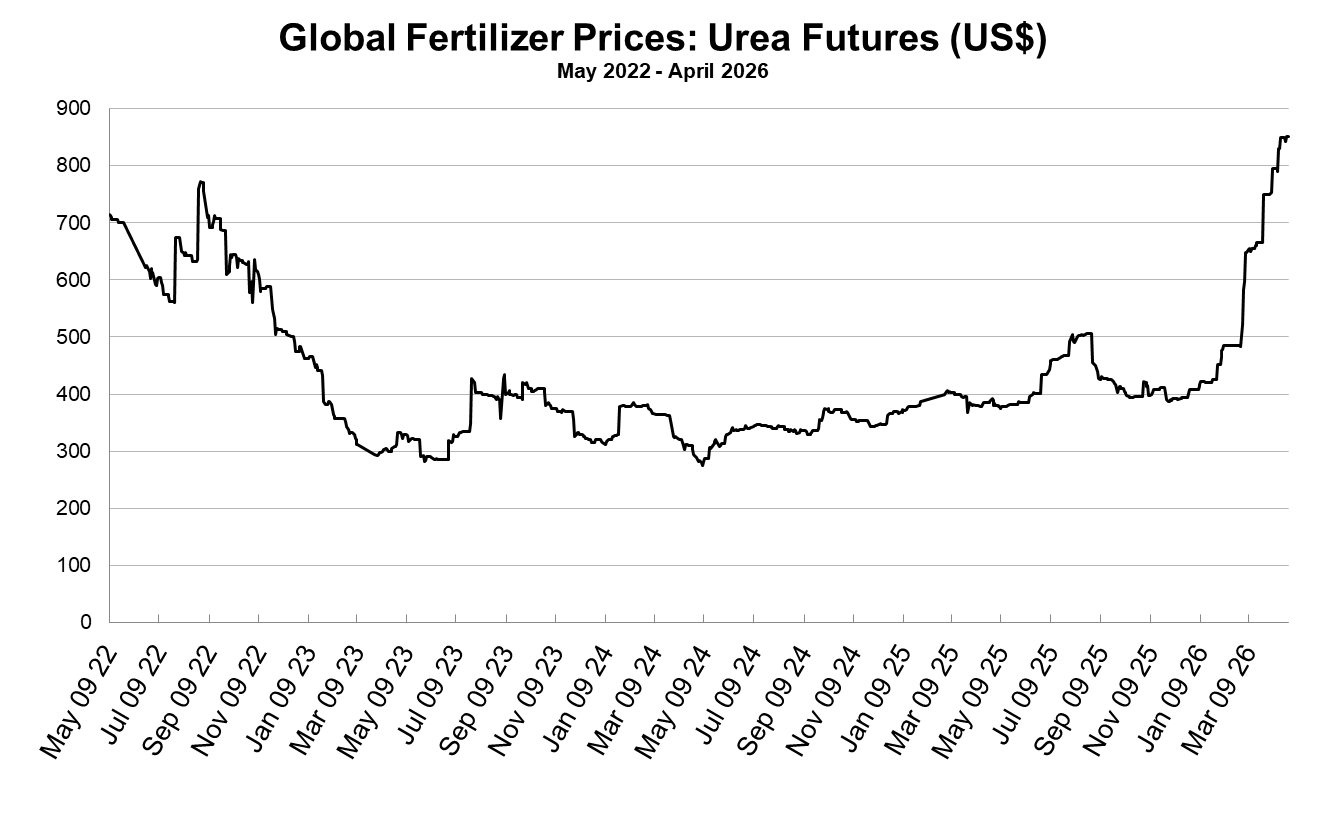
Source: CME Group, Prosera
Note: Urea Granular FOB Middle East (UMEc1). FOB: when the seller loads the urea on to a vessel and clears it for export at his/her own expense
Chokepoints and the Timing Trap in Agriculture
This introduces a second layer of risk: timing. The global food system depends on getting the right inputs to the right place at precisely the right moment. Disruptions at key chokepoints ripple outward, affecting planting cycles, harvests, and, ultimately, food availability.
Top 20 countries ordered by the FAO Indicator of Daily Food Prices Acceleration (standard deviations relative to average of previous 30 days)
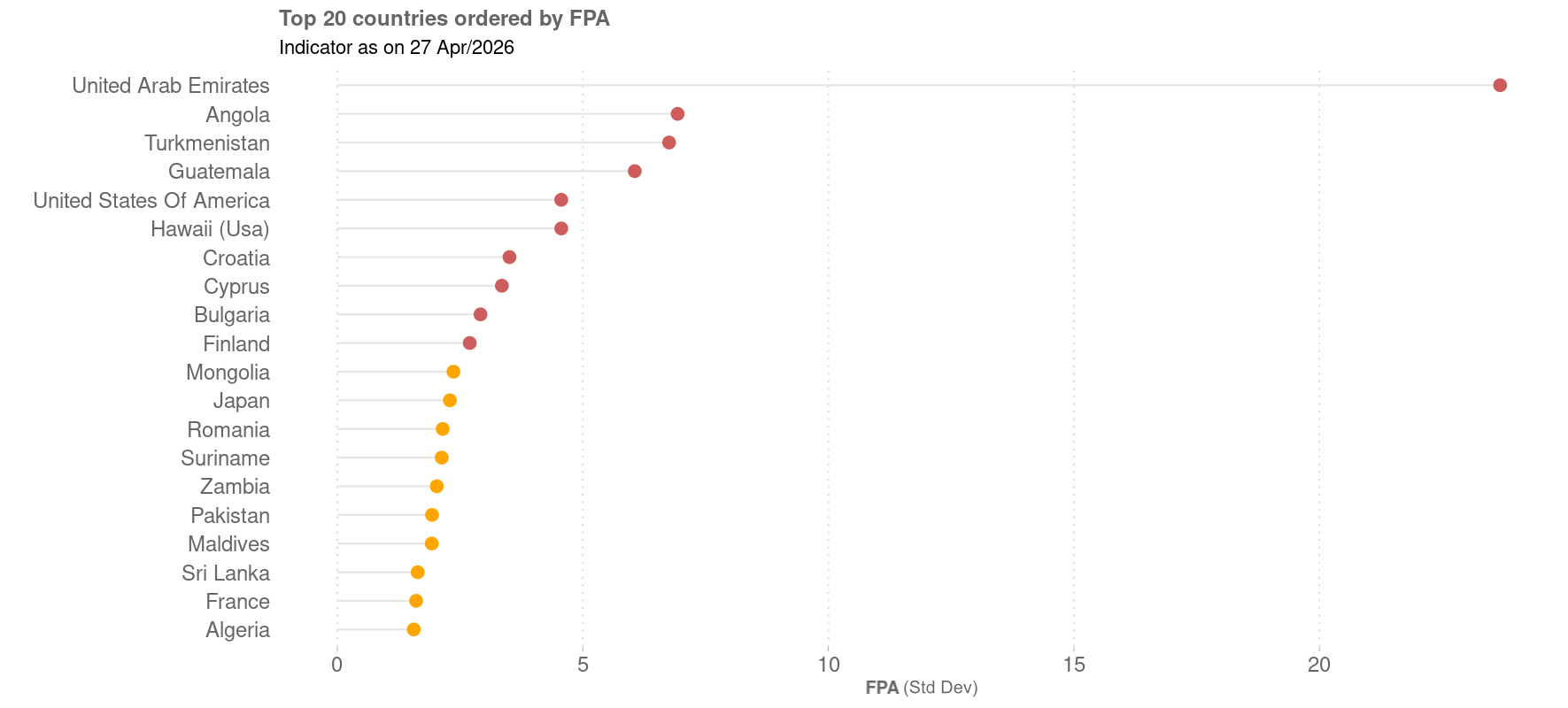
Source: Food & Agricultural Organization, Numbeo, Prosera
Note: The dots represent price acceleration of food on April 27, 2026 compared to the compounded growth rate over the average of the previous 30 days. The red dots represent greater than a 2.5 standard deviation; the orange dots are between a 1 and 2.5 standard deviation.
Compounding Risks: Geopolitics Meets El Niño
These risks are now compounding into three risks:
- Yield Compression: Lower or delayed fertilizer use.
- Price Volatility: Driven by shipping and insurance costs.
- Policy Stress: Export restrictions and stockpiling and hoarding.
Geopolitical disruption is colliding with climate uncertainty, including the possible effects of El Niño on weather patterns and crop yields later this year. The danger is not a single shock, but synchronization. Constraints on inputs could emerge just as environmental conditions threaten output.
The implications are already visible. Lower, or delayed, fertilizer use compresses yields. Supply chain disruptions increase volatility in both prices and availability. Countries may respond with further export and import restrictions, as well as stockpiling, and this would increase stress across global markets. What begins as a regional conflict could translate into broader food insecurity. Much will depend on the duration of the war.
Building Resilience in a Volatile Food System
In this environment, efficiency becomes a form of resilience. Reducing food waste is no longer just a sustainability goal, but a supply imperative. When inputs are constrained and timing breaks down, waste effectively removes scarce supply from the system. Better forecasting, inventory management, and supply chain coordination can help offset these pressures by preserving what is already produced.
Geopolitics is now embedded in the global food system. The longer the Iran conflict persists, the greater the strain through higher costs, lost output, and rising inefficiencies. If the war drags on, the result will be not just higher prices, but a food shock driven by the intersection of energy, logistics, and climate.