
“Rented Intelligence”
Most organizations are currently “renting” their intelligence. While third-party APIs offered a rapid entry point into the generative era, they have inadvertently created a structural liability. To build a true competitive moat, technical leaders must pivot from consumption-based dependencies to sovereign architectural integrity.
Jensen Huang’s recent open letter on “Open Weights and American AI Leadership” signals a definitive pivot in our industry. We are moving from the “demo phase”—where the promise of frontier AI was enough—to the “production phase,” where fiscal discipline and architectural sovereignty are the only metrics that matter.
This transition prompts a critical question, one Ashu Garg recently posed: is the real risk of AI that it is “too dangerous to distribute,” or is it actually “too dangerous to concentrate?”
When a handful of entities determine what gets built, what gets refused, and who gets access, the “long tail” of enterprise innovation is effectively gated. For an enterprise, AI is only useful if it is verifiable and controllable. If you cannot audit the execution path of your core business logic because it is locked inside a black-box model, you are carrying a technical and compliance risk that is simply incompatible with robust enterprise risk mitigation.
Sovereign Architecture
The Homogenization Trap
Beyond the fiscal costs of API dependency, there is a deeper danger: algorithmic homogenization. When firms in the same market sector all subscribe to the same frontier models for demand forecasting and procurement, they are essentially outsourcing their competitive strategy to a common, shared “brain.” If the same base model suggests the same logic to every player, no single firm maintains a strategic edge. Instead, the model acts as a performance equalizer, eroding the very competitive differentiation these firms have spent decades building. True competitive advantage requires a strategy built on proprietary judgment, not statistical averages.
To be clear: frontier models are the most potent cognitive engines we have ever built—essential for research, prototyping, and solving the “long tail” of unstructured tasks. However, the technology itself is not the problem; the architecture of delivery is. At Prosera, we navigated this by learning the hard way. Like many in the space, we initially relied on frontier models for speed. But as we integrated these systems into complex, high-frequency workflows, the friction became apparent: the token economics did not align with operational realities, and the latency of opaque pipelines hit a ceiling. We realized that instead of forcing our enterprise clients to adapt their business processes to the limitations of a monolithic model, we needed an architecture that adapted to them. This led us to evolve our stack into a three-tiered sovereign model:
Tier 1: Specialized SLMs: Domain-specific Small Language Models, containerized for the client’s secure VPC (e.g., logistics route optimization, inventory replenishment).
Tier 2: Private SOP Weights: Fine-tuned on proprietary operational procedures so that business logic is embedded, not just “prompted.”
Tier 3: Agnostic Foundation: Decoupling our application logic from any single underlying model, allowing for flexibility as the field evolves.
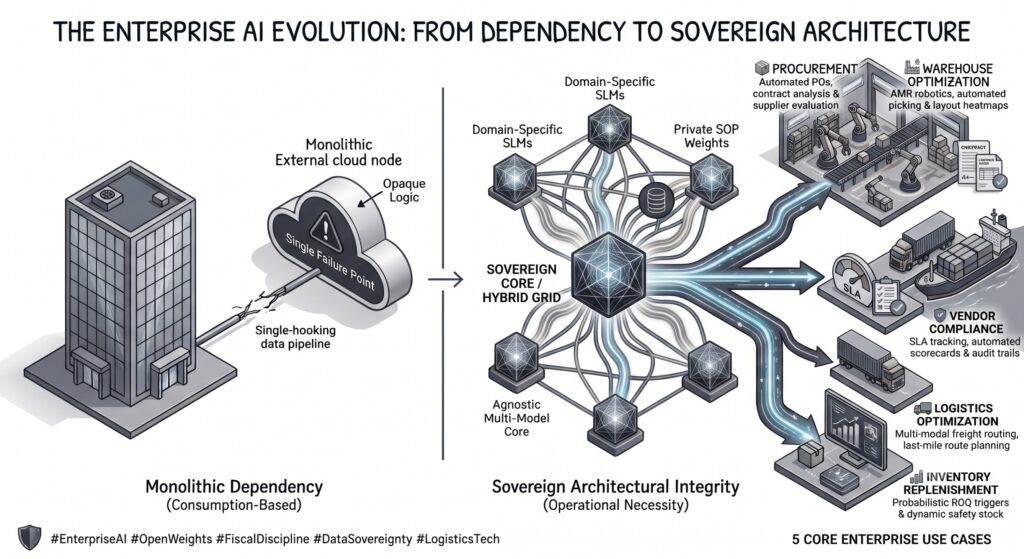
Concept diagram generated via Google Gemini
We also realized that true enterprise autonomy is not a “set it and forget it” exercise. It requires addressing two distinct challenges. First, generic frontier models can be “strategically blind”—they process statistical averages but often miss the why: the tribal knowledge and context that senior operators have cultivated over decades. Second, in production-scale enterprise workflows, data quality is an inescapable architectural design constraint. Despite massive investments in ETL and warehouse infrastructure like Snowflake or Databricks, real-world data across disparate ERP, WMS, and TMS systems remains messy and fragile.
Observability, Not Remediation
We don’t assume the data flowing through our stack is clean; solving lineage and integration at the ETL layer remains the remit of the enterprise data engineering team. Instead, we treat quality as an observability layer. Our ‘BluePipes’ agents perform real-time schema validation in situ. When a distribution shift threatens forecast confidence, we don’t hallucinate; we trigger an exception for human verification.
To bridge this, we architected a ‘Human-in-the-Loop’ protocol acting as an Interruptible State Machine. When agents hit a decision threshold requiring expertise, they transition to a ‘Pending Collaboration’ state. This creates a feedback loop that codifies institutional logic—turning tribal knowledge into verifiable assets rather than replacing the expert.
Conclusion: Building for Enterprise
For the enterprise, true advantage lies in proprietary judgment. Relying on an opaque frontier model means you are implicitly accepting the biases and statistical averages of that vendor’s training data. Prosera’s approach is fundamentally different: we inject domain-specific Standard Operating Procedures (SOPs) into the model weights. We aren’t just using an LLM to predict trends; we are embedding the client’s unique business logic—their operational DNA—into the execution path. This is how we ensure that the recommendation is not just statistically ‘correct,’ but strategically unique to that business.
The path forward isn’t to hope for different vendor policies; it is to compete by building resilient, sovereign architectures. Open weights are not a philosophical preference; they are an operational necessity for anyone aiming to put AI into the heart of a global supply chain. We are not looking for permission to innovate. Instead, we are building the cognitive infrastructure that allows enterprises to define their own standards of control and auditability.
Ultimately, the future of AI shouldn’t be a zero-sum game. The ecosystem needs both frontier closed models—for their sheer cognitive scale—and frontier open models to strengthen cybersecurity through inspection, accelerate innovation, and enable sovereignty. True progress lies not in choosing one over the other, but in harnessing both to build resilient, sovereign architectures that enterprises can trust.
This is the first in a series on the future of enterprise AI. In upcoming articles, I’ll be diving deeper into the technical frameworks we use at Prosera to deliver on these principles—specifically how our Compass™ Agentic Orchestration platform teamed with BluePilots™ delivers production scale auditable, operationally autonomous workflows.
I’m curious to hear from other practitioners: How are you balancing the immediate speed of frontier APIs with the long-term need for architectural sovereignty?