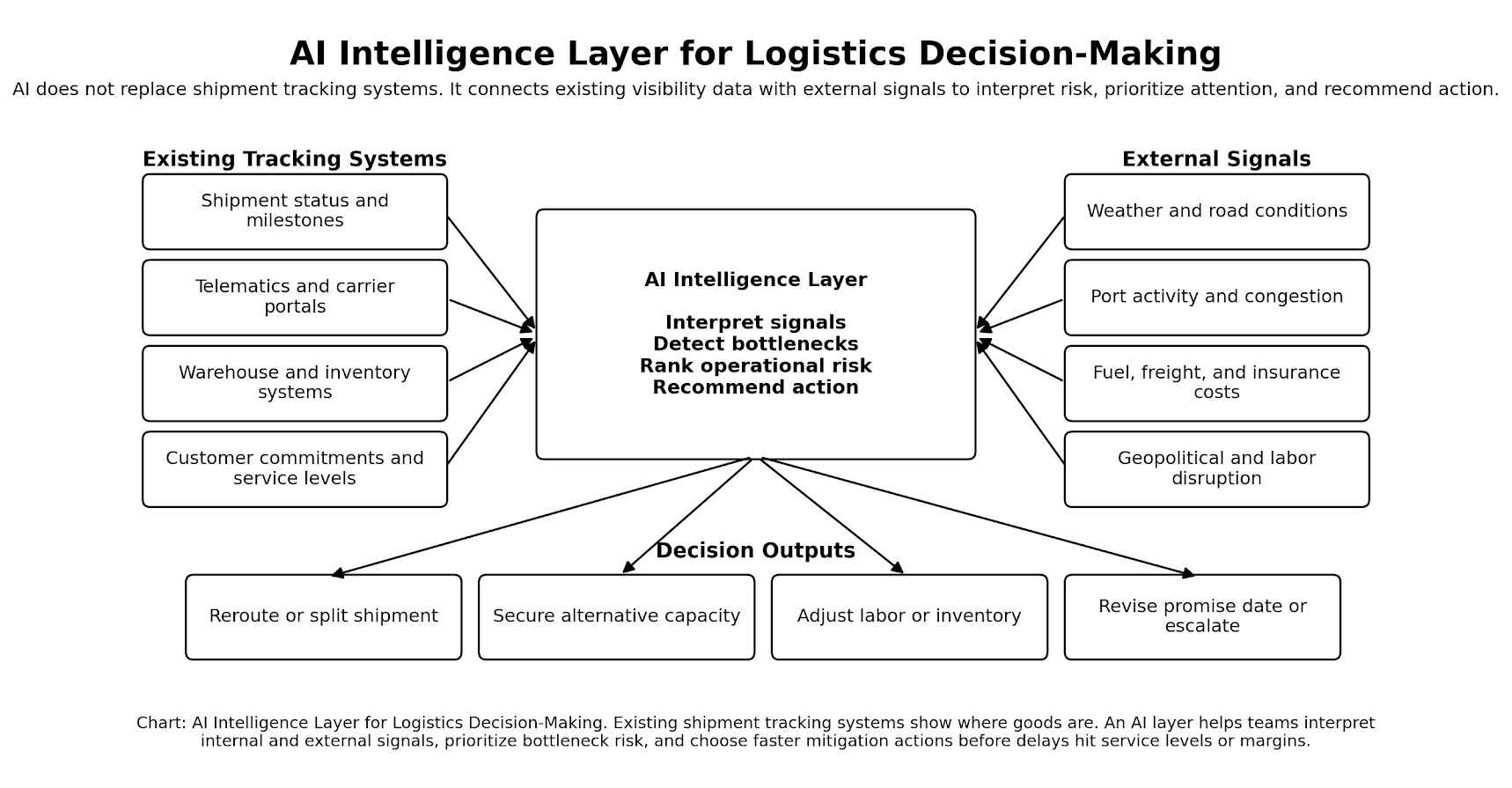
An artificial intelligence (AI)-driven decision intelligence platform can improve logistics decisions by acting as a digital coordinator that resolves issues – not just another automated way to create dashboards.
The world is facing a historic energy supply shock and deep uncertainty over the future of the Middle East. Flows through the Strait of Hormuz have been severely constrained, disrupting a chokepoint that normally carries nearly 20 million barrels per day of oil and significant volumes of refined products and liquified natural gas (LNG). Brent crude remains above $100 a barrel, diesel and jet fuel markets are under strain, and governments are responding with emergency measures to limit shortages, restrain hoarding, protect consumers, and manage exports.
For transportation and logistics firms, the shock has become a sustained supply chain stress test. Higher fuel, freight, insurance, and financing costs are hitting firms as workaround routes grow more congested, buffers thin, and service commitments become harder to meet.
Visibility Is Not the Same as Foresight
Transportation and logistics teams are already effective at monitoring the movement of goods across vessels, trucks, containers, warehouses, and delivery networks. Visibility platforms, telematics, carrier portals, warehouse systems, and customer-facing dashboards have made it much easier to know where goods are. Current platforms are adept at data aggregation, such as pulling electronic logging device (ELD), global positioning system (GPS), and application programming interface (API) data into one dashboard.
But knowing where a shipment is does not provide insight. Even platforms that use AI to predict arrival times can struggle when disruptions fall outside normal historical patterns, such as war-driven chokepoint closures, sudden tariff changes, insurance shocks, or cascading port congestion. Their models are trained on historical patterns, and historical data is a poor teacher when dealing with sudden geopolitical or market shocks.
Supply chain managers still find themselves responding to red alerts by picking up the phone, checking spreadsheets, and manually solving the problem because the platform does not offer a viable alternative. Most large shippers also use many different systems, creating internal silos. This creates a large unmet need for orchestration layers that can sync across these systems and help teams act.
Few platforms can answer tough questions such as which workarounds are most likely to fail? Which customers will feel the strain first? Where are costs becoming unrecoverable? And what should be done before delays hit service levels or margins?
This is the next frontier: moving from shipment tracking to bottleneck prediction.
The Hidden Costs of a Long Disruption
Logistics bottlenecks are rarely isolated operational events. They affect revenue, working capital, customer retention, labor planning, and profitability.
As for the latest supply chain disruption, even a reopening of the Strait would not immediately solve the problem. Drone, mine, and missile risks have made passage through the Strait harder to insure and more difficult for carriers to normalize quickly. Further, demining the Strait and restarting energy infrastructure could take months or years, depending on the scale of the damage. It will therefore remain expensive for logistics and shipping companies to resume pre-war shipping levels.
After months of disruption, the system would still have to absorb delayed vessels, displaced containers, crew constraints, customs bottlenecks, and missed warehouse appointments. Shipments are arriving in bunches, ports are struggling to clear volume, and warehouse networks are facing surges after weeks of shortage.
Even when ships reach port, the bottleneck may simply move inland. Many logistics teams still rely on spreadsheets and phone calls to confirm whether the right unloading equipment, railcars, trucks, warehouse slots, and labor crews are available. This creates unexpected dwell time and costly delays.
The longer disruption persists, the more fragile the workarounds become. Even if fighting ends, shipping would not immediately normalize. Elevated security risks, insurance constraints, vessel backlogs, and damaged energy infrastructure would likely delay a full recovery.
Predicting Operational Friction
An AI-driven decision intelligence platform can help logistics teams identify where pressure is building before it becomes a missed delivery, a customer escalation, or a margin problem.
One useful tool to resolve inland bottlenecks is a dwell app – software designed to monitor, analyze, and reduce the time transport vehicles spend stationary at facilities (loading docks, warehouses). By tracking these delays using GPS and geofencing, these apps help reduce detention fees, optimize labor, and improve supply chain efficiency.
If the system predicts a two-day delay, the decision layer should automatically identify affected downstream customers, recommend or trigger alternative routing, and adjust inventory replenishment triggers in the enterprise resource planning (ERP). Most current systems struggle to move beyond the first step.
A company can combine internal shipment data with external signals to identify emerging bottlenecks before they occur. Internal data can show shipment status, lane history, carrier reliability, delivery windows, warehouse capacity, inventory levels, customer commitments, and margin exposure. External signals can add weather, port activity, fuel prices, road conditions, geopolitical disruption, labor availability, customs delays, insurance conditions, and regional demand patterns.
Such an early warning system does not simply add more data. The value is turning data into judgment at speed.
The same logic applies upstream. If buyers routinely place orders after the required master service agreement (MSA) window but still expect the original delivery date, the company may be forced into expensive air freight. A decision intelligence platform could flag the behavior, quantify the cost impact, and help supervisors correct the process before late orders become recurring margin leakage.
Acting Before Costs Escalate
Consider a distributor moving high-priority refrigerated goods through a lane exposed to constrained capacity and tight receiving windows. A standard tracking system may show that the shipment is still manageable. But an intelligence layer could detect that the risk profile is deteriorating because fuel costs are rising, carrier performance is weakening, warehouse capacity is tightening, and the customer has limited inventory on hand.
This combination changes the risk profile. Instead of waiting for a delay to occur, the logistics team could intervene earlier by changing the route, securing alternative capacity, shifting inventory, adjusting labor at the receiving warehouse, revising the promise date, or communicating proactively with the customer.
From Alerts to Recommended Action
The goal is not to replace existing shipment tracking systems. The opportunity is to build an intelligence layer on top of them, one that provides insights to help teams interpret signals, prioritize risks, and act faster.
A logistics risk radar could show where operational and financial risk is building across lanes, shipments, carriers, warehouses, and customers. Instead of treating every alert equally, it could identify which problems matter most by weighing delay probability, cost exposure, inventory criticality, and customer impact.
The recommended action matters as much as the alert. A useful system should not merely say that a lane is at risk. It should help determine whether the best response is to change the route, switch carriers, expedite selectively, shift inventory, revise the customer promise date, or escalate the issue to a manager.
The Next Advantage in Logistics
Instead of asking teams to monitor everything, companies can direct attention to the shipments, lanes, warehouses, carriers, and customers that matter most. Instead of treating exceptions as surprises, firms can identify patterns that indicate where service failures are likely to occur. Instead of reacting with costly last-minute fixes, logistics teams can choose lower-cost interventions earlier.
The commercial value of AI in logistics is not more data for its own sake, but better decisions under pressure.
The next advantage in logistics will not come from knowing where every shipment is. It will come from knowing which shipments are likely to become problems, how much those problems may cost, which customers are exposed, and what action to take before the bottleneck breaks the plan.