
The disruption in the Strait of Hormuz is both a fuel price shock and a supply chain planning problem. When fuel is cheap, companies can absorb more planning mistakes. When fuel prices spike, every unnecessary mile becomes a margin problem.
The effective closure of one of the world’s most important energy chokepoints has pushed crude oil prices sharply higher, raised diesel, jet fuel and marine fuel costs, and forced companies to rethink how they move goods across global and regional networks. Brent crude is trading close to $108 per barrel, up by roughly half since military action that began Feb. 28 effectively closed the Strait of Hormuz to shipping traffic. The U.S. Energy Information Administration warned that if the closure lasts through June, oil prices could be roughly $20 per barrel higher than current forecasts.
For companies that rely on trucks, aircraft, vessels, refrigerated transport and frequent replenishment, this is not only a commodity price shock. It is also a margin shock, a routing shock and a forecasting shock.
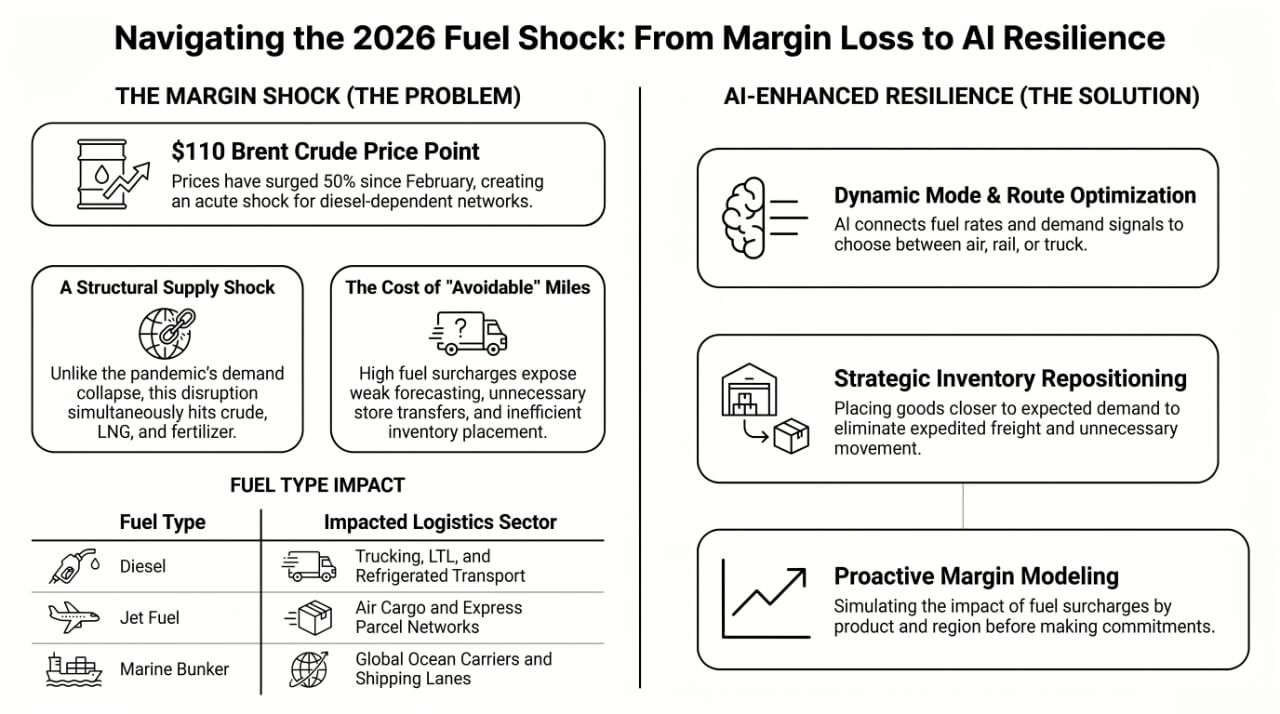
A more damaging fuel price shock for supply chain operators than the pandemic
The Covid-19 pandemic created an enormous energy disruption, but it was primarily driven by a sudden collapse in global demand. Travel stopped, freight patterns shifted, oil demand fell and prices plunged.
The current Middle East disruption is different – it’s a supply shock affecting crude oil, refined fuels, LNG, fertilizer, petrochemical inputs and shipping lanes at the same time. That makes the operating challenge more acute for companies that need to keep inventory moving.
The International Energy Agency (IEA) has described the Strait of Hormuz disruption as “the largest supply disruption in the history of the oil market.” Global oil supply fell sharply in March because of attacks on energy infrastructure and restrictions on tanker traffic. The IEA has also warned that commercial oil inventories are being depleted rapidly, with strategic reserves helping to cushion the market but not providing a permanent solution.
The timing of the war makes the shock harder to manage. The Northern Hemisphere is entering the summer travel season, when gasoline and jet fuel demand typically rises. At the same time, supply chain operators are already planning for back-to-school, fall retail, and the early stages of year-end holiday season inventory positioning. If fuel prices remain elevated, the cost pressure will not stay confined to energy markets. It will increasingly move into freight rates, air cargo, ocean shipping, last-mile delivery, cold-chain logistics, and inventory placement.
The disruption has materialized in two ways: price and physical displacement
On price, higher Brent crude prices feed into diesel, gasoline, jet fuel, marine bunker fuel, heating oil, lubricants, petrochemical feedstocks, and other petroleum-linked inputs. For supply chain operators, diesel and jet fuel are especially important. Trucking, LTL, drayage, field service, and refrigerated transport depend heavily on diesel. Airlines, air cargo operators, and express parcel networks depend on jet fuel. Ocean carriers depend on marine bunker fuel.
Fuel costs also move quickly into freight pricing. Many LTL and truckload contracts include fuel surcharges indexed to U.S. Department of Energy diesel prices. The Department of Energy’s own fuel surcharge guidance notes that truckload and LTL fuel surcharges are calculated using the DOE U.S. average on-highway diesel price. C.H. Robinson noted in March that sustained oil market volatility could keep upward pressure on fuel surcharges and all-in freight transportation rates for shippers.
Regarding physical displacement, the Strait of Hormuz disruption follows years of compounding supply chain shocks: the pandemic, Russia’s war in Ukraine, Red Sea shipping disruptions, and now a major Middle East energy shock. When routes become unreliable or too expensive, shippers seek alternatives. Some cargo shifts from ocean to air. Some long-haul movements shift to rail or intermodal. Some companies use trucking to work around port or route disruption. Each shift may solve one problem while creating another: higher cost, longer lead times, tighter capacity, or greater operational complexity.
Companies face two cost problems
The first problem is the absolute cost of moving goods. When fuel rises, mode choice becomes more important. Air freight is fast but expensive. Ocean freight is cheaper but vulnerable to chokepoints and delays. Rail and intermodal can reduce fuel intensity but may reduce flexibility. Truckload and LTL remain essential for domestic distribution, but fuel surcharges can rise quickly.
The second problem is the avoidable cost of moving goods unnecessarily. A retailer that frequently transfers inventory from one store to another is not only paying transportation costs. It is paying for imperfect demand allocation. A convenience chain that receives frequent fresh deliveries is not only paying for fuel; it is paying for the cost of freshness, availability, and short shelf life under volatile conditions. A field service company that rushes parts across regions is not only paying for freight. It is paying for weak parts positioning and poor demand forecasting.
AI-enhanced planning can reduce the damage
AI-enhanced supply chain planning can help companies connect fuel prices, freight rates, demand signals, inventory positions and service commitments before transportation decisions are made.
For example, an AI-enhanced planning system can help companies decide whether to:
- Move product by air, ocean, rail, truckload, LTL or intermodal.
- Consolidate shipments instead of sending smaller loads more frequently.
- Reduce store-to-store transfers through better demand forecasting.
- Reposition inventory closer to expected demand.
- Adjust delivery frequency for fresh or refrigerated products.
- Avoid expedited freight by identifying supply gaps earlier.
- Route around chokepoints before capacity tightens.
- Model the margin impact of fuel surcharges by product, customer, route or region.
The objective is not simply to reduce freight costs. It is to make better operating decisions under stress.
Conclusion
The Strait of Hormuz disruption is exposing a hard truth: that fuel shocks punish weak planning.
Companies that manage this shock best will not simply react faster, but use better forecasting, routing, inventory allocation and scenario planning to avoid unnecessary movement in the first place.
Fuel shocks do not just raise freight costs. They expose avoidable movement, weak forecasting and poor inventory allocation.