
The closure of the Strait of Hormuz has made freight efficiency a strategic priority. Logistics providers cannot control oil prices, tariffs or geopolitics. But they can reduce waste inside the freight networks they already manage.
Freight Costs Have Become a Strategic Risk
Since the U.S. and Israel attacked Iran on February 28, the de facto closure of the Strait of Hormuz has pushed energy markets into a period of sustained volatility. Brent crude prices rose from roughly $72 per barrel before the attack to $93 per barrel by June 9, an increase of nearly 30%. The U.S. Energy Information Administration (EIA) also expects global oil inventories to fall sharply through the second quarter, keeping upward pressure on crude prices.
Higher crude prices have increased the cost of shipping freight. As the chart below shows, ocean freight shipping costs and the global spot market rates for air cargo have risen sharply since February 28.
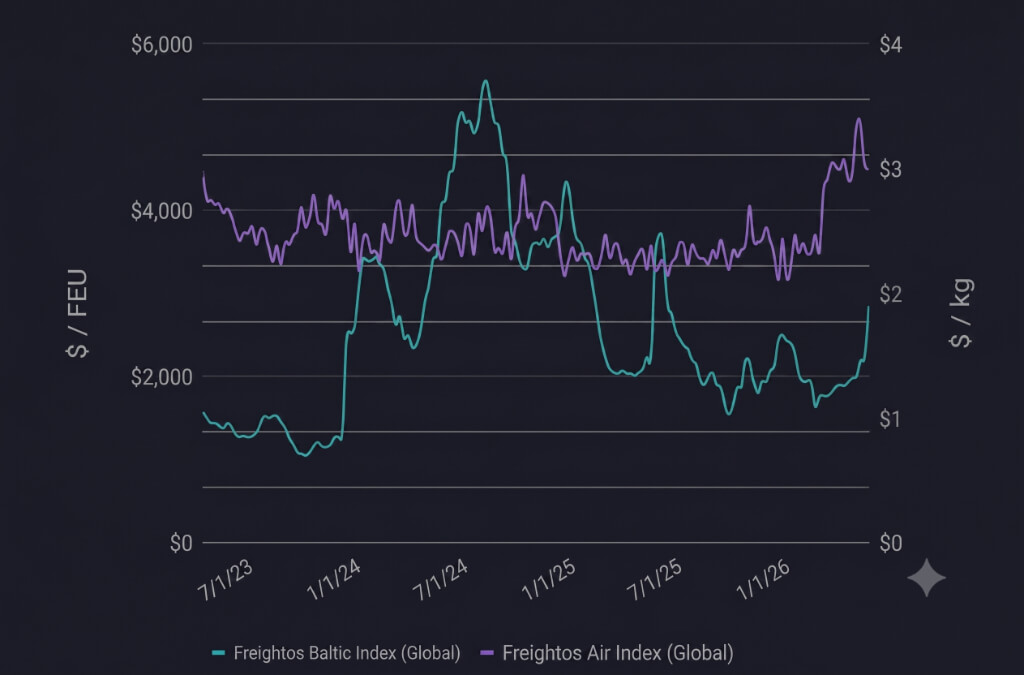
Source: Freightos, Prosera. Note: Freightos Air Index (purple, left axis), Freightos Baltic (Ocean) Index (green, right axis). To June 5, 2026. A forty foot equivalent unit (FEU) is a shipping container whose internal dimensions measure about 40 feet long, 8 feet wide, and 8 feet tall.
Volatility Is Testing Logistics Execution
The Hormuz crisis follows the pandemic, tariffs, and disruption in the Red Sea, Ukraine, and the Middle East. These shocks have made fuel, freight, insurance and routing costs more volatile, while inventory buffers are being drawn down. The result is higher freight costs, greater routing uncertainty, more customs complexity and tighter financing conditions. This has increased the need for 3PLs to improve efficiency wherever possible.
For third party logistics providers, or 3PLs, this is more than a macro shock. 3PLs are outsourced operators that help other companies move, store and coordinate goods across a supply chain. They execute logistics strategies and make daily decisions about fuel, freight, insurance, routing, inventory and customer service.
3PLs Cannot Control Geopolitics, But They Can Control Capacity
3PLs cannot control the timing of a Middle East peace agreement, the reopening of the Strait of Hormuz, or the path of Brent crude. Nor can they control tariffs, emergency surcharges or customer demand. But they can drive resilience by dynamically mitigating surcharges, co-managing customer demand, and unlocking the hidden efficiencies in the capacity they do control.
Hidden Inefficiencies Are Now More Expensive
3PLs are well-positioned to address several hidden inefficiencies in freight networks. These include wasted capacity in underfilled shipping containers, partially loaded trailers, inefficient routing, and siloed vendor coordination.
These problems are not new, but with higher fuel and freight costs they have become more expensive. Logistics networks also tend to rely on fragmented systems and manual workarounds. As experienced managers retire, companies risk losing the practical knowledge that helps teams navigate lanes, carriers, customs requirements, consolidation rules, and exceptions.
Traditional Planning Tools Are Not Enough
Traditional logistics systems help companies track what is happening. Transportation management systems (TMS), warehouse management systems (WMS), and enterprise resource planning systems (ERP) can monitor shipments, transactions, inventory and warehouse activity.
But tracking is not the same as optimization. These systems often do not help 3PLs make real-time tradeoffs across vendors, lanes, service commitments, fuel costs, freight rates, and financing constraints. This matters because logistics decisions are connected. A routing change can affect cost. A consolidation decision can affect delivery speed. A warehouse constraint can affect the entire network. 3PLs are well-positioned to manage these tradeoffs, but AI-enhanced planning tools can help 3PLs evaluate them together rather than in isolation.
AI-Enhanced Planning Can Close the Execution Gap
AI-enhanced planning can help 3PLs move from reactive execution to adaptive planning.
Decision intelligence systems can connect information that is often scattered across the logistics network. They can help planners see when freight should be consolidated, when a route should change, and when a faster shipment is worth the extra cost.
The value is not simply automation, but better decision-making. AI-enhanced systems can evaluate more feasible options, compare tradeoffs faster, and help teams choose the plan that best balances cost, speed, reliability and working capital.
From Freight Tracking to Decision Orchestration
For 3PLs, the goal is not simply to track freight, as most logistics firms already do. The goal is to orchestrate better decisions across the entire logistics network.
Faced with persistent shocks, improved logistics performance will come from using existing capacity more intelligently. AI-enhanced planning can help 3PLs to gain predictive visibility into inbound, upstream freight so that they can plan the optimal consolidated mix, taking into account customer business requirements.
Given the higher cost of moving goods, the most cost-effective capacity gains will come from evaluating more options faster, and making better use of the networks that logistics providers already manage.